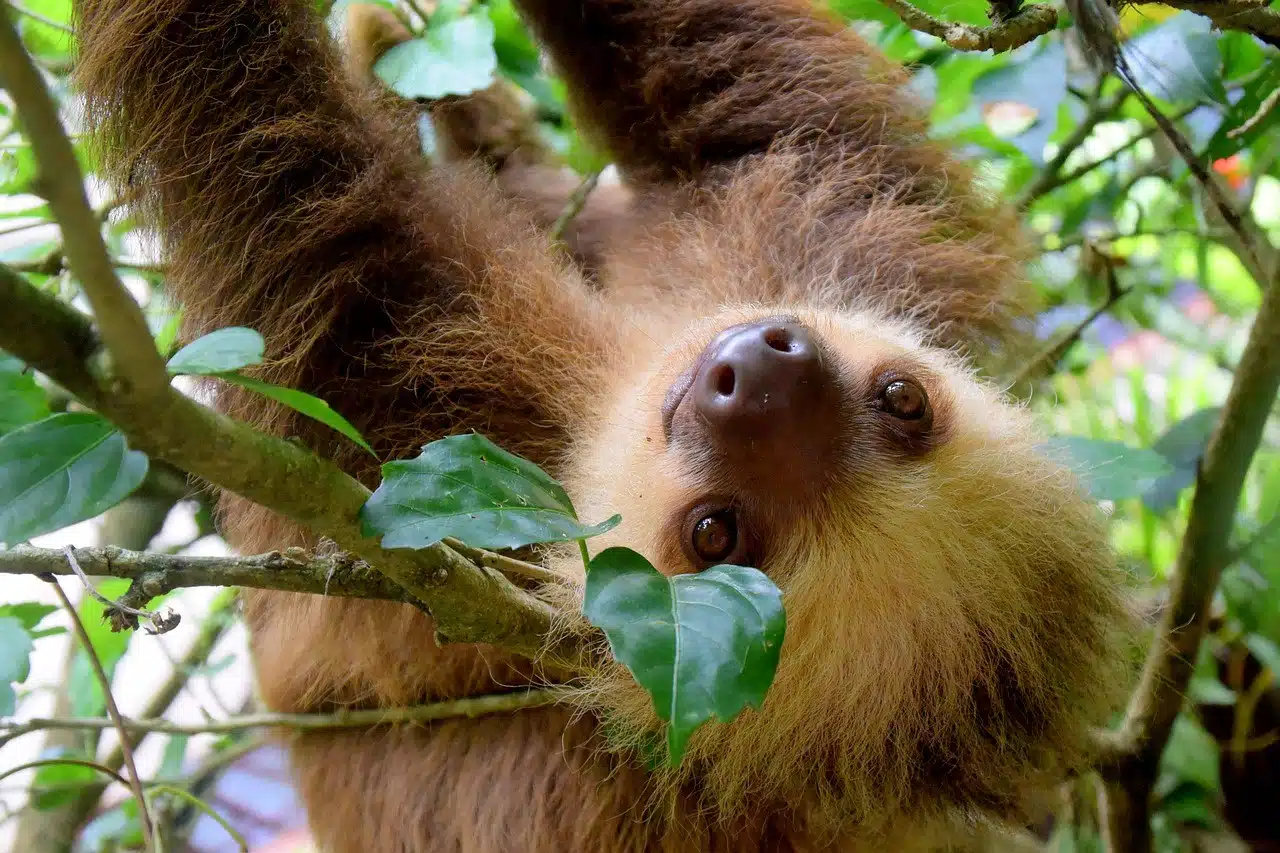
They move so slowly that algae grows on their fur, giving them a greenish tint that doubles as camouflage. They sleep up to 20 hours a day. And yet, sloths are among the most successful mammals in the tropical forests of Central and South America. In Costa Rica, they have become true ambassadors of the country's wildlife, captivating visitors from around the world.
Costa Rica is home to two species of sloths: the two-toed sloth (Choloepus hoffmanni) and the three-toed sloth (Bradypus variegatus). Both can be found in the lush forests around La Fortuna, and while they may seem similar at first glance, they lead very different lives.
Two-Toed vs. Three-Toed: Knowing the Difference
The three-toed sloth is the one most people picture — the adorable face with a permanent "smile," a compact body, and a short tail. They are strictly herbivores, feeding on leaves from a select group of trees. Three-toed sloths are diurnal, meaning they're active during the day, which makes them easier to spot on guided tours.
The two-toed sloth, on the other hand, is larger, more muscular, and nocturnal. They have a more varied diet that includes fruits, insects, and even small lizards. Their longer arms and more prominent claws give them a different silhouette in the canopy. Spotting one during a night walk is always a special moment.
Masters of Energy Conservation
Sloths are the ultimate energy conservers. Their incredibly slow metabolism — the lowest of any non-hibernating mammal — allows them to survive on a diet of leaves that would starve most other animals. They digest food so slowly that a single meal can take up to a month to process.
This metabolic strategy extends to everything they do. Their body temperature fluctuates with the environment, they rarely move more than 40 meters in a day, and they descend from the canopy only once a week to defecate — a behavior that remains one of the great mysteries of sloth biology.
The Sloth Ecosystem
A sloth is not just an animal — it's a walking ecosystem. Their coarse, grooved fur hosts a remarkable community of organisms: algae, fungi, beetles, cockroaches, and even moths that live exclusively in sloth fur. Scientists have discovered that sloth fur contains compounds with antibiotic, antifungal, and even anti-cancer properties, making sloths a subject of pharmaceutical research.
The algae growing on their fur serves a dual purpose: it provides camouflage against predators like harpy eagles and jaguars, and it may also serve as a supplementary food source that sloths lick from their own fur.
Where to See Sloths in La Fortuna
The forests around La Fortuna are prime sloth habitat. The abundance of cecropia trees — a favorite food of three-toed sloths — makes this area particularly productive for sloth spotting. On our Sloth & Wildlife Tour, we visit several proven locations where sloths are regularly found.
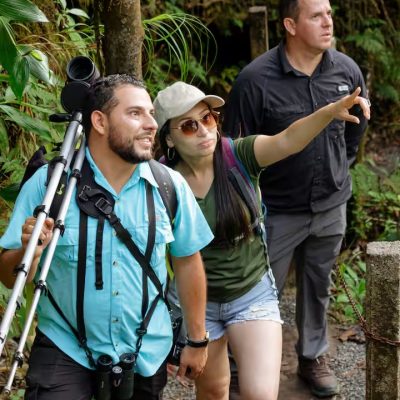
The key to finding sloths is knowing what to look for. To the untrained eye, a sloth looks exactly like a clump of leaves or a termite nest. Our experienced guides use professional spotting scopes and binoculars to locate these masters of disguise, often pointing out sloths that visitors would never find on their own.
Conservation and Threats
Despite their popularity, sloths face real threats in Costa Rica. Habitat fragmentation forces them to cross roads and power lines, leading to injuries and death. In La Fortuna, local conservation groups work to install wildlife bridges and rescue injured sloths for rehabilitation.
At Rain Forest Experiences CR, we believe that responsible wildlife tourism plays a crucial role in sloth conservation. By helping people fall in love with these remarkable animals, we create advocates for the forests they depend on. Every tour is conducted with strict guidelines to minimize disturbance — we observe from a respectful distance, never touch the animals, and keep noise to a minimum.
A Moment You'll Never Forget
There's something profoundly moving about watching a sloth in the wild. Perhaps it's their gentle nature, their impossibly calm expression, or the way they seem to exist in a different time dimension than the rest of us. Whatever it is, the moment you lock eyes with a sloth high in the canopy — through the lens of a professional scope that reveals every detail of their face — is a memory that stays with you forever.
In a world that moves faster every day, sloths remind us that sometimes, slow is exactly the right speed.
Ready to Experience It Yourself?
Join our expert naturalist guides and discover the incredible wildlife of Arenal up close. Small groups, professional equipment, and unforgettable memories.
See Our Tours BelowRelated Tours
Sloth & Wildlife Tour
Through a guided safari in the rainforest, you can enjoy these beautiful and interesting mammals in their natural habitat, as well as observe other animals such as monkeys, toucans, frogs, and more.
View Details & Book
Arenal Hanging Bridges
With more than 250 hectares of forest, the hanging bridges reserve is the perfect place to learn from a naturalist guide about the natural history of this ecosystem. Walk at canopy level across 6 hanging bridges and observe animals such as monkeys, birds, snakes, and much more.
View Details & Book